Try the zipper around the corners
A zipper's smooth movement matters most when the bag is curved and filled, rather than empty and flat.
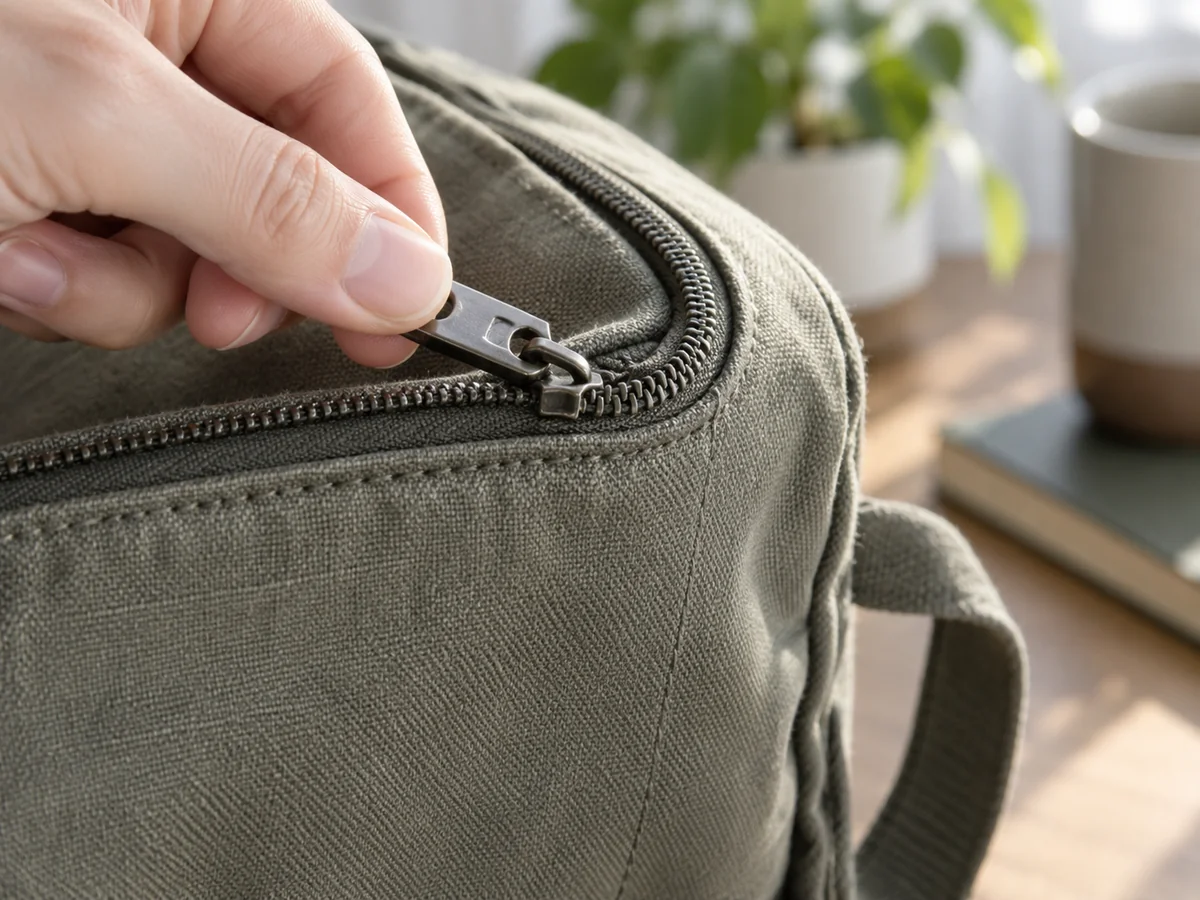
Follow the whole route
A zipper can slide easily along a straight section and catch at the first corner. Test its entire route, including the point where it starts and the final few centimetres. Curved openings place the fabric and teeth at changing angles, so support the bag as you move the pull. You should be able to open it with a steady movement rather than a sharp tug.
Look for lining or loose cloth close to the teeth. If material is caught, stop. YKK advises easing the slider back while freeing the trapped fabric rather than forcing it forward. Pulling harder can make the jam worse. Repeated catching at the same point on a new bag is worth raising with the seller, particularly if the lining consistently folds into the closure.
Add the things you intend to carry
An empty bag does not show how a zipper behaves under pressure. Place your usual contents inside, leaving space rather than testing the largest possible load. The two sides should come together without squeezing a rigid object underneath them. If the closure stretches around a bottle or tightly packed books, rearrange or reduce the contents before pulling it shut.
The opening must also suit your hands and objects. A compact pull can be neat but difficult to grip, especially with cold fingers or limited dexterity. A wider opening may help you retrieve a pouch without scraping it against the teeth. Notice whether handles, decorative tabs or a dangling strap interfere with the slider. A smooth fastening is less useful if something blocks it every time.
Read protective claims precisely
Coated fabric and a specialised zipper are separate components. A conventional zipper does not become waterproof because it is sewn into a water-resistant bag. Even a protective closure may have particular limits or care requirements. Look for the maker's description of the complete product instead of inferring performance from a glossy strip or hidden teeth.
Do not apply a household lubricant simply because the zipper feels stiff. Oils can spread into fabric, and some specialised fasteners require specific products or no treatment at all. Follow the manufacturer's instructions for that model. If stiffness is caused by a badly aligned seam or damaged teeth, lubrication does not correct the underlying construction problem.
Check the ends for tidy stitching and adequate room for the slider to park. You may prefer two pulls on a large opening, but more hardware is not automatically an advantage on a small pouch. The practical test is simple: can you reach the contents and close the bag without a struggle at its corners? A closure that works naturally encourages you to use it properly.
Further information