Keep sweatshirt cuffs from stretching
Treat cuffs as a fitted part of the garment, rather than a handle or a place to park rolled sleeves indefinitely.
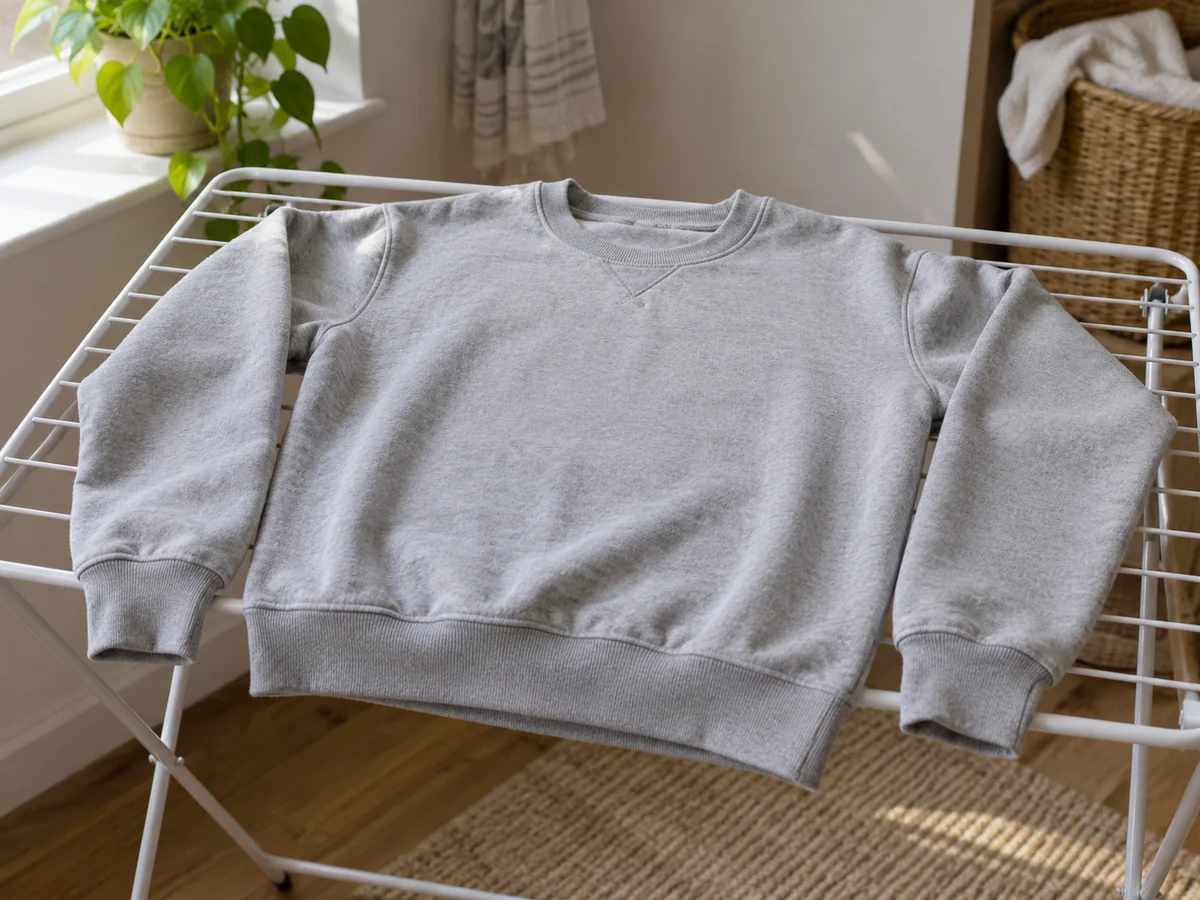
Pay attention to the repeated pull
Sweatshirt cuffs are repeatedly stretched over hands, pushed up forearms and pulled back down. Some movement is part of their purpose. The aim is not to keep the rib untouched, but to avoid unnecessary strain that becomes a daily habit. Notice whether you remove the garment by hauling on one cuff or leave the sleeves tightly rolled for long periods.
When taking a sweatshirt off, support the sleeve rather than using its end as a handle. If the opening is difficult to pass over your hand even when the garment is new, the cuff may simply be wrong for you. Repeatedly forcing it is not a reliable way to improve the fit.
Wash and dry the whole shape
Follow the care label for the garment and any decoration. When the sweatshirt is wet, lift it with support beneath the heavier parts rather than by the sleeves. A damp body contains more weight than a dry one, and a narrow cuff should not be asked to carry it.
If the instructions permit gentle reshaping, smooth the cuff into its normal outline without pulling it longer. Lay or hang the garment in the recommended way. A drying position that lets the sleeves dangle under unnecessary weight can create a different shape from the one you wanted to preserve.
Avoid trying to tighten a loose cuff with a burst of high heat. The cuff, sleeve body and print can respond differently, and the treatment may affect parts of the garment that already fit well. A home remedy that produces a short-term change is not the same as restoring the original construction.
Store it without leaving the cuff under tension
Fold the sweatshirt with the sleeves resting naturally. Do not keep a cuff stretched around an oversized hanger end, a storage hook or another object. For clothing you wear frequently, an ordinary clean, dry drawer with enough room is usually more practical than an elaborate display arrangement that distorts the fabric.
If a cuff has already become loose, inspect whether the rib itself has changed or the joining seam has failed. Those are different repair problems. A person experienced in garment alterations may be able to replace or adjust the cuff, but the result depends on the fabric, available matching material and the sleeve shape.
For a future purchase, test the cuff in the positions you actually use: at the wrist, behind a watch and lightly pushed up. Choose one that feels comfortable without constant pulling. Good care begins with a suitable fit, then removes the extra stress that does not contribute anything useful to wearing the garment.