One useful pocket beats several awkward ones
Judge a pocket by what you can reach and retrieve, rather than by the number on the product listing.
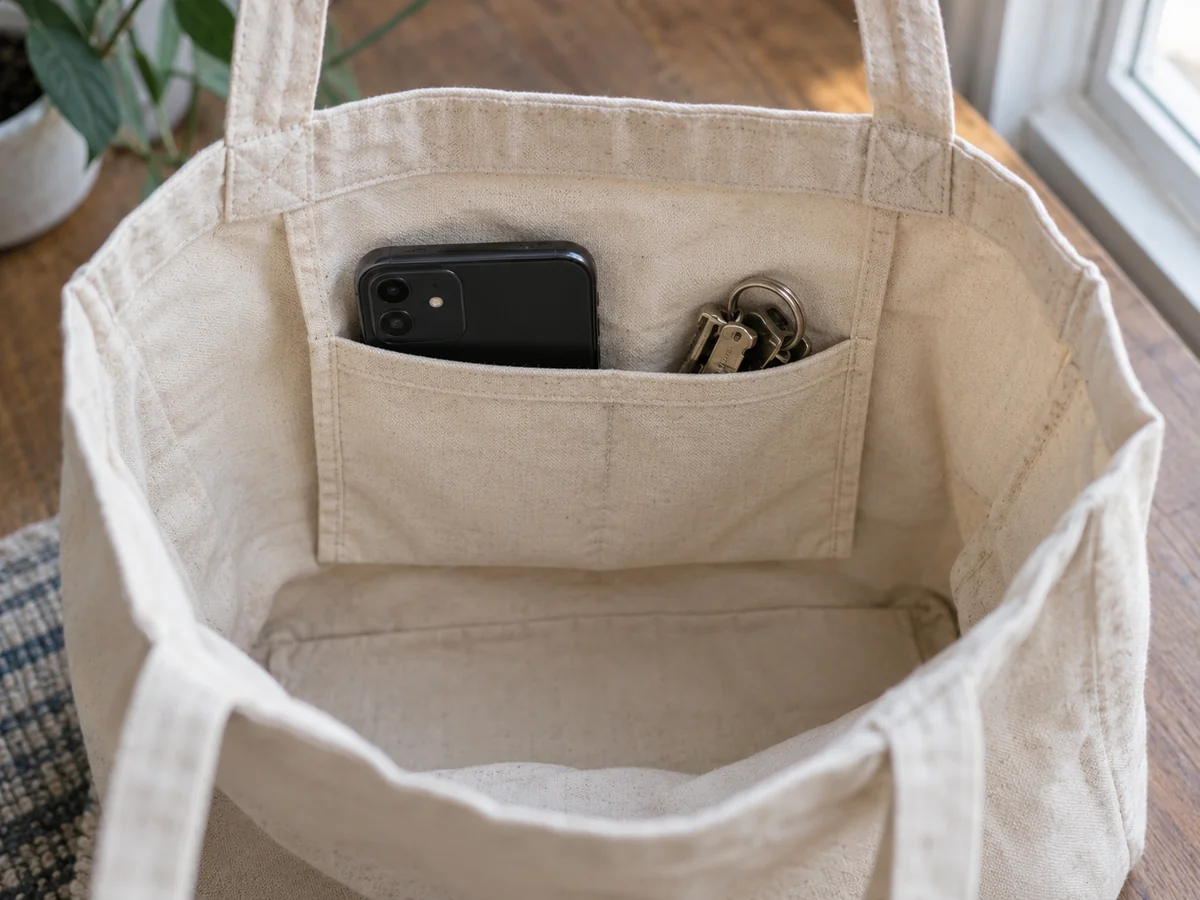
Give the pocket a job
A pocket earns its place when it keeps something useful where your hand expects to find it. That might mean your keys above the books, a phone away from a metal buckle or a travel card close to the opening. Start with the object that currently disappears inside your bag. Its size and the way you retrieve it give you a better buying brief than a promise of “multiple organiser pockets.”
A shallow open pocket can be convenient for an item you reach for often, but its position matters. If it hangs near a flexible rim, the contents may tip out when the bag slumps on a seat. A deeper pocket offers more coverage, yet a small key can become difficult to reach. Try inserting and removing the actual object rather than judging an empty compartment by eye.
Check access with the bag packed
Put a notebook or another flat object into the main compartment and see whether the pocket remains usable. Some inner pockets lose space when a large item presses against them. Others are positioned behind the thing you naturally pack first. A pocket that is easy to use on a display table may require unpacking half the tote during an ordinary journey.
For a phone, allow for the case and camera bump. A snug slot advertised around a bare handset can be awkward once the device is protected. Check whether you can hold the bag and take the phone out with your usual hand. If the opening is zipped, your fingers need space to grip the pull without scraping against the teeth or stretching the seam.
Think about where weight sits
Several heavy things in one hanging pocket can pull the lining away from the body. A bunch of keys, power bank and wallet may be better divided between a stable compartment and a small pouch on the base. Pocket count alone does not tell you how a tote will balance. Notice whether the bag twists or becomes uncomfortable against your side when that pocket is filled.
An external pocket gives quick access but leaves its contents more exposed to weather and casual loss. An internal zip pocket offers a closure, although it should not be treated as theft-proof storage. Choose placement according to the journey and keep important items under your control. A key leash can also be helpful, provided it is attached securely and does not snag other contents.
One simple pocket with the right depth may solve the whole problem. For occasional extras, a removable pouch lets you transfer small objects between bags without buying a more complicated tote. Give every compartment a plausible task before paying for it. Empty pockets are harmless; awkward ones become daily reminders that organisation has to fit the way you actually pack.
Further information